Up next in 10

George Takei on Star Trek’s 60th Anniversary, the Vulcan Salute, and Fighting Injustice SpaceCon '25
Nov 2, 2025

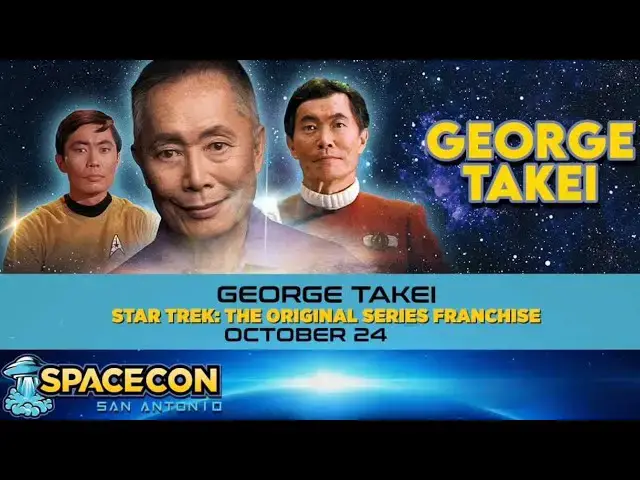
Recorded live at SpaceCon San Antonio on October 25, 2025. George Takei (Hikaru Sulu from Star Trek: The Original Series) sits down for an hour of stories that hit fandom, history, and responsibility as a citizen.
Takei opens by thanking the crowd for keeping Star Trek alive for nearly 60 years, pointing ahead to 2026 as the 60th anniversary of the franchise. He talks about creator Gene Roddenberry and the core idea of IDIC — Infinite Diversity in Infinite Combinations — and says the cast itself was meant to show a future built on diversity, cooperation, and shared purpose.
He shares how Leonard Nimoy came up with the Vulcan salute. According to Takei, the original script just had Spock greet alien visitors with a standard handshake, but Nimoy argued that reaching forward like that could read as aggressive. Nimoy suggested an open hand, fingers split, as a peaceful way to show “no weapon.” The director loved it, and that gesture became one of the most famous images in Star Trek.
Takei then goes personal. He talks about being a Japanese American child during World War II and being forced with his family into U.S. incarceration camps behind barbed wire and guard towers. He explains that his parents were American residents building a life in California, and that armed soldiers still showed up, took them from their home, and held them without charge or trial. He describes how that experience shaped his lifelong push for civic engagement, participation, and speaking up any time the government crosses constitutional lines.
From there, he connects that past to the present. He urges fans to stay active in democracy, vote, volunteer, and defend due process so constitutional rights aren’t taken away from the next generation. He credits his father for teaching him that freedom requires work and that silence is not neutral.
He also talks about building Sulu: insisting the character reflect not a stereotype, but a capable, skilled Asian American officer on the bridge of the Enterprise. He tells the story of lobbying to fence with a rapier in “The Naked Time,” taking his shirt off, and loving every second of it. He laughs about mispronunciations of his last name (“It’s Ta-KAY — ‘Takei’ means ‘expensive’ in Japanese”) and still throws up the Vulcan salute to close.
Recorded and posted by Tales From The Collection.
Subscribe for more celebrity panels, live Q&As, and convention coverage from SpaceCon, GalaxyCon, Fan Expo, and more.
Show More Show Less View Video Transcript
0:07
Welcome, welcome to Texas. Extreme honor to have you. Thank you very much.
0:18
We call it Star Trek, but uh this was a star wobble this.
0:26
Thank you all for being with us. Uh I we we could use more of you. I see some
0:32
empty seats. They just said the announcement out that
0:38
uh we are on stage and living long and prospering as you are.
0:50
And we have a great deal to thank to all of you because
0:56
next year is 2026. Exactly 60 years since was born back in
1:06
1966.
1:14
And let us do I see any balm heads or
1:19
gray hair? Because those of you that were around then that help us helped us
1:26
make that long journey. 60 years of Star Trek and
1:33
to the to those of you had who have a lush head of hair and were born in the
1:39
21st century. Thank you for knowing your
1:44
history and joining the team and
1:50
making Star Trek live long and prosper.
2:01
And so with that word of appreciation to all of you, those of you around who
2:09
survived and When I see empty seats, I also see the
2:15
people who occupied them uh empty seats,
2:21
but people who contributed to this incredible phenomenon and some of them
2:29
are people like Jean Rodenary who created the show, his vision of our
2:37
whose philosophy was Idiot I D I C. Infinite diversity in
2:45
infinite combination. And that's all of you. And
2:54
those empty seats represents people who preceded you, who created this
3:01
phenomenon called live long and prosper Star Trek. Thank you all very much.
3:16
So, you mentioned Gene Rod's, you know, vision. What made it so timeless and
3:21
how, you know, ahead of its time was this whole idea of what we see 60 years later? It's incredible.
3:28
Oh, it's very incredible. There they are. Alive and living. And Star Trek is
3:35
living long and prosperous. So don't say it's incredible.
3:41
We are very alive and I mean I'm I may
3:46
be hobbling but uh my spirit is still there and the gratitude is always in us
3:59
and I think of Leonard Nemoy great actor but also a wonderful friend.
4:09
uh he was the one that uh created this uh gesture of both me. We were filming
4:16
and on the script the script said uh there was a team of uh alien
4:24
beings coming on board and Leonard or Scott is out there to greet them with
4:32
this and exhend you know welcoming uh handshake. But
4:40
Leonard said, "No, this is a a very aggressive move uh move to to go forward
4:47
with their hand like this. They don't know us and we don't know them. They
4:53
don't know our culture and they may be startled by this
5:00
being coming across extending your hand. It should be something much more
5:07
specific. peaceful and nonaggressive
5:13
and he said this gesture is an open hand showing I have no
5:21
weapon and so he suggested what about this gesture the director said fantastic
5:29
that's wonderful that was Leonard Nemoy who offered this idea and I think that's
5:37
a wonderful idea and it's become a part of Star Trek and I've uh incorporated this gesture as my
5:47
welcoming gesture at all the Star conventions.
6:02
Do you remember the exact moment you realized Star Trek had become something bigger than just a TV show?
6:10
Well, because I like to think I'm a visionary.
6:18
But we were filming the pilot film and uh uh Jimmy Doom who played the Scott.
6:26
Yes, let's give him a hand. But I'm not giving a hand to the fact
6:33
that he was a chain smoker. He needed a smoke and he didn't want to
6:39
be off the sound stage all by himself. He said, "George, come on out and chat
6:45
with me while I have a smoke." So I went outside with him and he Jimmy asked me,
6:54
"What do you think is going to happen with this pilot film? do you think it will sound? And I said, "Oh, I smell
7:02
quality about this show." Jean Rodney Rodbury has a great philosophy. And I
7:11
can see the other actors in this cast are very fine actors. They're bringing
7:18
their own own individuality. And I've seen a couple of scripts and
7:25
they are substantial. They have meaning. They have uh great dramatic scenes,
7:33
action, suspense. And so I have a
7:38
feeling this show is going to be a great hit. We haven't even sold yet, but I
7:45
said it's going to be a hit. It's going to live long and prosper. And guess
7:50
what? It has.
8:01
So Suma became a symbol of optimism, intellect, and courage and amongst more.
8:06
How did you make that role your own to ensure you stood out amongst the iconic crew?
8:13
Thank you for my strength seems to be leading me and
8:20
yeah making these water bombs titled water.
8:26
Thank you very much. Uh so uh what was the question?
8:33
How did you make the role of Sulu your own in a church he stood out among such an iconic crew?
8:43
Well, the acronym live long and prosper uh
8:49
meant we're going to be uh depicting the future of civilization, diversity,
8:58
people of different histories, different backgrounds, different viewpoints,
9:04
different talents. And so I said, I'm Asian. Asian-American
9:11
and I'm part of the diversity. Uh that's going to be an important part of what
9:18
this show is about and that's what the future is going to be about. people of
9:25
different backgrounds, different values, different ages, and looking around, you
9:32
see that diversity. And so I'm adding
9:39
uh that diversity. And I I I I said I'm
9:45
an American of Japanese ancestry and I lived through a chapter of
9:53
American history where America made a dreadful mistake.
10:01
Pearl Harbor was bombed by Japan. My grandparents came to this country and
10:08
they were farming in the Sacramento Delta in California and my mother was
10:13
born and she married my father who came from Japan. His mother passed
10:22
and my grandfather his father decided he wanted to start life a new.
10:31
So he came to San Francisco with us two boys. My father being the younger one.
10:37
And my father was raised and educated in San Francisco. And he married my
10:45
mother from Sacramento. And uh I was the first born. And then
10:51
next my brother Henry was born. And then my sister was born. But when they were
10:59
when my sister was a baby, I was 5 years old.
11:05
This country couldn't tell the difference between Japanese Americans
11:12
and Japan had gone to war and President
11:17
Franklin D. Roosevelt was stampeded by the hysteria that swept
11:25
through the country and he ordered all Japanese Americans
11:31
uh on the West Coast should be mounted up and put in prison camps.
11:38
And that was an illegal act because we have a system called due process. When
11:45
people are rounded up, they have a right to know why we're rounded up.
11:52
They the only reason that they uh have uh to categorize us was
12:00
they they thought we were enemy aliens. That was crazy. We're three generation
12:07
Americans. We're not the enemy and we were aliens. We were born American.
12:14
And yet the country went hyster uh hysterical
12:20
and that affected the process as well. And we were put in these barbwire prison
12:26
camps, sentry towers, machine guns pointed at us. I had a dozen tanks
12:34
patrolling the perimeter. There were 10 of these camps in some of
12:39
the most godforsaken places. We were in prison in the swamps of Arkansas.
12:46
Others were uh imprisoned. I'm a blistering off desert of Arizona
12:55
uh New Mexico uh or the high plains wins
13:04
of Wyoming Idaho Utah Colorado
13:10
for no reason that this made up fiction that we were enemy aliens.
13:17
We had there were no charges. So therefore no trial
13:23
just simply imprisonment and soldiers came to our homes banged on
13:30
the front door pointed uh bayonets at us at my father and that
13:38
shocked me when they put pointed that bayonet at my father. We were frozen
13:44
with terror, but we were ordered about like that and imprisoned for the duration of the year.
13:52
And then they they decided were no longer a threat. It was crazy. Absolutely crazy. And we
14:00
know that America can go crazy. And that's why I wrote the book Strian, the
14:07
newest one I am now, Mr. P. that rhymes with tequil
14:19
last month. But previously I am a book
14:25
signing my lost freedom or a boundless enemy or to the stars
14:33
uh which uh in which I talked about my Star Trek uh adventures with my colleagues. But uh
14:42
I wanted America to know that history because there is an important lesson in
14:49
that and clearly we have not learned the lesson because we're doing all
15:02
you know federal uh milit militian
15:10
coming into our states. First was Los Angeles, then Chicago
15:18
and Portland, and now they're talking about San Francisco.
15:24
The same thing that happened to us for which President Ronald Reagan in 1988
15:32
apologized saying saying it was a grievous mistake and made paid a $20,000
15:41
of reparations to those who were alive at that time in 1988.
15:48
I got my $20,000 as a child who lived through that. But
15:54
the ones that suffered the most were people like my father and people of his
16:00
generation who had already passed and the law said you had to be a living
16:07
survivor. My father never knew that the president
16:14
would apologize. So we need to apologize to all the people
16:22
that are being subjected to this aggressive force by a current American.
16:30
I call him not a president but a cling on
16:45
all you have. We know that you understand what's happening now happened
16:55
uh back in 1942
17:00
to us. We know and enough Americans know that to know that what's happening today
17:08
is unconstitutional. At least the soldiers that rounded us up
17:14
uh were armed and in uniform, but they didn't have masks. Today, they I guess
17:22
by showing that they are ashamed of of themselves because they are masked, but
17:28
that they're that much more threatening. We Americans know and we are ultimately
17:36
going to win in this fight.
17:50
Who were some of your your heroes or role models, you know, growing up? The people that maybe inspired your sense of
17:57
creativity, the storytelling, and even even justice.
18:02
Well, the person that really inspired me the most was my mom. He went through that hell
18:08
having taken h everything that he and my mother worked to uh build a a
18:16
two-bedroom home on Donald Street in Los Angeles. He had his business destroyed. And so he
18:25
is my biggest hero. And after the war, he's the one that taught me about our
18:33
democracy. And he often quoted to me person Abraham Lincoln who in the
18:40
Gettysburg address said ours is the government of the people by the people
18:46
and for the people. But he's saying
18:51
the people are citizens and with that uh with the the rights of
19:00
the people by the people for the people comes responsibility
19:06
and there were people that resisted uh
19:13
Roosevelt's uh imprisonment but he said people are fallible human beings. And he
19:21
said he was he admired President Roosevelt during the depression of the
19:28
197 uh devastating economic u
19:35
depression. But Roosevelt knew how to
19:41
stir the spirit and the determination of the of the people. He said to them,
19:48
"There's nothing to fear but fear itself." And he did galvanize people and
19:55
brought the economy up. But he was also
20:01
as well as being a great president. He was a founding human being. And when
20:09
Arbor was bomb, he got swept up in the same hysteria because he was a valuable
20:17
human being. And he said,
20:23
"Our country is made up of great people, but also fellow people who make
20:29
mistakes." And he he told this was when I was a teenager and I was having after dinner
20:37
conversations and he said I want you all my children to know that lesson of
20:44
American history to participate in democracy.
20:50
Speak up when you see something is wrong and actively participate in the process.
20:58
So I want my children to at school to volunteer for uh charitable causes,
21:06
join all the clubs and participate in student activities. And so I became a
21:15
volunteer for the a junior Red Cross. Uh I volunteered
21:21
uh in various other uh charitable causes and uh I was voted uh chairman of the
21:31
junior red cross. Then I was a local student body president and so I became
21:37
actively involved and I I'm passing on to you the lesson that my father taught
21:45
me. We in a democracy a people's democracy
21:51
people have responsibility to keep it what it should be. A nation of laws, a
21:59
nation of people who take on the responsibility for those laws. We have
22:06
laws of due process. When people are arrested, they have to have a charge for
22:14
them. Not just being rounded up. And
22:20
uh if they come up with a charge, the people have the right to challenge those
22:26
charges in a court of law, a trial, and then if there if they come up with
22:34
evidence of uh wrongdoing, then you're free. If you are responsible, then
22:44
you're punished. And so I became active in political Romania. I volunteered for
22:52
the first president volunteered for was Adley Stevenson. Some of you may most of
23:00
you may not remember that name, but he was a great governor of the state of uh
23:06
Illinois and fantastic speaker. And of
23:11
course he didn't get the nomination that year. a young, bright, shiny politician from
23:20
Massachusetts, a senator named John Kennedy, one became the president
23:29
of the United States. And that's the way it's supposed to go. And uh I have a
23:37
tendency to ramble. Uh I forgot the question.
23:42
Maybe I am
23:51
your father being you know your role model growing up. Where does creativity come from and can someone kind of help
23:57
push you more into the creativity you more to be an actor? Yes. Well, actually
24:07
I want he wanted me to be an architect and so like a good son I began uh my
24:14
college career as an architecture student at UC Berkeley and and it was
24:21
interesting. I liked architecture but uh my real passion
24:28
which kept which I kept to myself was acting theater and finally that passion
24:35
got stronger and harder and I said to my father I want to go to
24:43
New York and study at the actor studio and he said well
24:51
the actorudio studio is a respected acting school. People like Marco,
25:01
but he's not any
25:09
um what when you finish at the actor studio, they won't they won't give you a
25:17
diploma that says you're an educated person. and just say you know you're a
25:23
good actor or you're a lousy actor and he encouraged you to quit uh and
25:30
just say uh give you you know your active training. He said if you must
25:36
study acting and I really your mother and I want you
25:42
to have an achievement academic degree. So, right here in town in Los Angeles at
25:50
UCLA, they have a fine theater arts department. And when you finish, they
25:58
will give you a diploma, uh, a bachelor's degree.
26:04
And so, if you do that, we will subsidize you. If you go to New
26:12
York, you go to New York all on your own. I was a practical kid.
26:21
I went with the subject and I'm glad I did because it was a fantastic
26:27
experience. Uh I got the best supporting actor award two years in a row at uh
26:35
UCLA and then they just gave me the degree and said you gone.
26:41
uh I they giving the other guys enough competition and I wound up with my first uh grown up
26:51
in uh a movie version of uh
27:01
a southern novel Ice starring Richard.
27:06
He became my idol. And then uh I saw
27:12
Errol Flynn in the adventures of Robin Hood and I love Errol Flynn. In fact,
27:20
when uh that script um had me
27:26
um initially when the scripts had me brandishing a samurai sword and I said
27:33
yes, I'm Japanese American and uh samurai
27:39
uh Japanese warriors, but I'm Japanese
27:45
American and I saw up field as Robin did
27:51
and I was swept away by that. I love fencing. So, why don't we put a fencing
27:58
boy in George's hands as and
28:04
the director said, "Great idea." And I went to town, had a great time, took my
28:14
shirt off, but I swear. And that is the episode
28:20
that is my favorite from the television series.
28:29
We are so brave over
28:45
the EI is what people have trouble in Spanish. Uh, it's vowels are just
28:54
like in Spanish.
28:59
E is pronounced A and I is pronounced E. A te.
29:06
And when you say pronounce it Tai, there is a Japanese word pronounced Tai. And
29:15
you may not know that a guy means
29:20
expensive. So you got it's not the usual fee, but
29:27
you'll have to pay half your fee for mispronouncing.
29:41
Heat. Heat.
30:06
I love
30:17
each other.
Arts & Entertainment
Social Issues & Advocacy
Discrimination & Identity Relations
Human Rights & Liberties